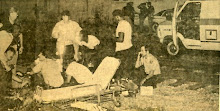
They took him off life support today. We went to high school together, then it being 1967 he went into the army and I went into the Marines. We both joined the department in the 1970's and retired about the same time. He was one of the first medics. Fought more fire than most. Now he is gone. When the shit was deepest, you would look around and there stood Nick getting it done. He was one of the best. Anyway here's to you Nick, there are damn few of us left.
Monday, October 19, 2009


Wednesday, September 30, 2009
The Old Days
This is a great little documentary about the early days of EMS. If you can stand some of the editorial comments and it is slow at times it is a real look back. I became a EMT in 1974 and a paramedic in 1977. The names of the physicians and early programs were considered cutting edge. I think it is important to understand how far we have come since those years. I had forgotten just how controversial it all was in the beginning.
Tuesday, September 29, 2009
The Twenty Percent Rule
A doctor once told me that 40% of the patients I would see in EMS would die no matter what I did, another 40% of the patients would live no matter what I did, but there would be 20% where what I did would make a difference. He told me to hold on to that 20% because it was all you were going to get and it would have to be enough.
Monday, September 28, 2009
What Separates Us
A fire station is a unique environment. It is connected to the nervous system of the community it serves. A nervous system that finds every trash fire, car fire, house fire, woman not breathing, child hit my a car, accident with injuries, shooting, stabbing, overdose, difficulty breathing, drowning, cardiac, asthma attack and every other type of personal disaster imaginable. It exists outside the bubble of safety that it helps create for everyone else. When we walk into the station we become part of the nervous system. We become part of all the bad things that happen in our community. We gain knowledge that few outside the station understand exists.
Even if it is not your call, there is this constant litany of emergencies over the radio as other units are dispatched. We stand in the open bay doors and watch children play and ride their bikes in front of the station, while you are listening to units at a shooting on the west side of town. Or you are having breakfast as Engine 6 and Rescue 6 have a woman not breathing. You are cleaning the truck as Engine 2 and Rescue 2 have a stabbing. Then your tones go off and you have your own emergency to manage.
Civilians are the people who live that bubble. That sphere of safety created by us in stations across the city. The bubble where they went to work, ate, slept and played and nobody got hurt or died. Where they felt safe and secure knowing that help is only a phone call away no matter what the emergency. Where they could walk around and not worry about anything except what their own self interest, because when that bubble burst they knew that with a simple phone call we would come and fix whatever was wrong. Our job was to create the bubble and when it burst it was up to us to try to put it back together.
So while we sit in the station in the midst of all of the peace and quite of the neighborhood around us, we are part of this nervous system. We are no longer part of the peaceful world. We are part of the nervous system that can jerk us into the midst of any emergency imaginable. Our job is to create a perceived bubble of safety for our community that protects it no matter what happens. No matter how bad the situation we respond and try and put the pieces back together so people can feel safe again. Can feel protected again. Our job is to try to keep the bubble intact.
When we go to work somebody usually dies, maybe not in fire but in small ways like the auto accident, the drowning, the cardiac, the shooting, the stabbing, or just the end of living a good long life. But somebody died, we live in a world where the unthinkable can and does happen, a world where people die sudden and sometimes ugly deaths. They all had lives and they were over now. Where things are not nice and neat. Where life seems to leave a lot of loose ends. Loose ends that most people only deal with once or twice in a lifetime if they are lucky. These small personal tragedies are our job.
So we enter the real world where actions had terrible consequences. We live with a profound truth that had been lost in our modern society, that death is very near to all of us and it doesn’t take much to cross that line. The great “they” have forgotten it. Modern society seems to try and convince everyone that death is somehow this unusual event. This news-making story of horror. Death is in all our futures in one-way or another. No amount of exercise, diet, drugs or laws will change that ending. Yet in today’s society everyone is so shocked when death does come close.
The nightly news anchors always frown and show concern when they report one of our incidents before moving on to the next story. Secure in the knowledge something so terrible could not happen to them, because they occupy the most protected part of sphere that money, fame and privilege provides. But when it happens to one of them watch their faces. Everything is more real to them. Suddenly it could happen to them and people they know it. But those of us who climb onto the trucks, we have the knowledge. We know how close it is. We think we are smart enough, tough enough and lucky enough to dodge the chances we take on the job long enough to die peacefully in bed.
Because we take that knowledge away from the station, we live with it everyday, it is ground into us. We see life through this new prism. When we walk down the street, go to the beach, go out to eat, we see things that others don’t. We walk in the sphere with the others, but we are always looking for the cracks or leaks that if you are not careful, could make you an accident victim.
We feel separate and apart from those without the knowledge. It is why we spend so many of our off hours with one another. No one else understands. When we tell a story the other guys laugh when they should and shake their heads when they should. It can put up a permanent wall if you let it. This reality pushes you from other people. Friends ask “What happened lately? Do you have any good stories?” But to us, these people are not just stories. They are people who bleed. Who cry. Who die. So you answer “Ah, nothing much happened.” Because when we tell a story if it is for the vicarious thrill of somebody, it diminishes the pain of the victim and our efforts.
What we did is not a story. What we did was a desperate attempt to beat back the inevitable in many cases. But it is our job to try. Certain events stuck in our mind the way signposts draw you attention on the Interstate. They are turning points. Point of reference. Many times they are turning points in our own lives. What we did. What we saw. What we heard. What we tried to do. How we tried to help sometimes can fundamentally change who we are, and how we view the world. And yet none of these events make the headlines. They are the little articles on page two in the local section of the paper, but we carry it around with us each day for the rest of our lives. It separates us from those around us who don't have the knowledge who don't understand. It is the reason that even after thirty years when I see someone I served with we shake hands, smile and ask how they are doing, but there is always a moment that we exchange a glance, a recognition of someone else who knows, who understands, who has the knowledge. The knowing makes us part of a brotherhood. A brotherhood that separates us from those around us and places us the outside the bubble we created.
Thursday, September 17, 2009
Memories
I hear the sirens and air horns now, especially the air horns. Not every time I hear them, but sometimes. Suddenly I am back on the trucks. Pulling on my bunker gear. Looking up a street on the map. Shouldering the straps to my air tank. Pulling up my three quarter boots. Putting on my gloves. I am back in it. I am back on the street. I can almost hear the radio traffic.
“Engine 1, Engine 51, Tower 1, Rescue 1, District 1 house fire….”
“Engine 7, Rescue 7 shooting. OPD is not on the scene….”
“Rescue 1, Rescue Boat 1 respond to assist Engine 7 and Rescue 7 with a drowning….”
“Engine 6, Engine 4,Crash 6, Rescue 6, Tower 1, District 1 plane down…”
“Engine 3, Rescue 3 person not breathing…”
“Engine 10, Tower 10, Rescue 7 District 2 accident with injuries involving entrapment…”
I can almost feel the adrenaline rush. See the red lights of the trucks. Hear the roar of the diesel. Then dispatch would give the report that always meant you had something serious.
“We are receiving multiple calls.”
“We have reports of people trapped.”
“CPR is being performed.”
Then I find myself listening for the reports from the first units to arrive.
“Engine 1 to dispatch we have heavy fire showing from a single story wood frame structure. We are pulling an inch and three quarter line.”
“Engine 6 to Orlando we have a single engine plane down in a tree. No fire. But we do have a fuel leak. Be advised the passenger and the pilot are trapped.”
I am back on the street. That mystical place I named so long ago, the other reality that exists just outside most people’s everyday work a day lives. It is a place that seems to exist in parallel to daily existence. Yet it is only a car accident or cardiac away for everyone.
The street was more than a physical place. It was a place where all of the safe guards end, and my job begin. It is a place filled with excitement, fear, tragedy, horror, sadness, despair, joy, and laughter. It was a place where everyday decisions had terrible consequences. I am going to the grocery store, or I will fix the wiring fixed next month. Where people died or were horribly injured because of these simple daily decisions. It was terrible place, or maybe it is reality. It was where I worked.
The street existed in the poorest homes in Orlando, and in the richest. It existed in back alleys and the main streets. It existed in brush fires, house fires, shooting, stabbings, hangings, cardiac’s, codes, drowning’s, and a thousand other emergencies. It was everywhere. I have houses or intersections that had been scenes and now were signposts in my life. That house is where I pulled the woman out of the fire that afternoon. I pass the intersection where all those people died on that Thanksgiving night when I go to the YMCA. I can see where I had the double shooting from the East/West Expressway. I can see where we tried to save a mother and three children that night in that fire, each time I get on the interstate. Across the street from those apartments is where we found that body that had been undiscovered for three days in the Florida heat. The reminders of the street and the years I spent on it are everywhere around me, like some kind of map of my life. A map that marks life-changing event for me and those I tried to help. Even now, thirty years later, the memories they produce are as strong as ever.
Tuesday, May 27, 2008
Street Wisdom
"The longer I am on the street the fewer answers I have. You lose your illusions. Your view of things leaves little room for wanna be’s or should have’s. People with answers still have too many illusions. Reality leaves no room for illusions."
Written my a much younger me, circa 1980's.
Sunday, May 25, 2008
Suicides are Not Painless
Suicides are painless. That line from the MASH TV show theme ran through my head the other day and I thought of the man with no face. Suicides are not painless. In fact they inflect more long lasting pain than they relieve. I discovered this the night a man put a shotgun under his chin and pulled the trigger. I had been to many attempts and successes over the years but this is the one that stands out above the others.
The only furniture in the apartment was a single chair. There was no TV, no table, nothing but this single chair in the apartment. The man had placed the chair in the center of the room and put the shotgun under his chin and pulled the trigger. When we arrived we found him still sitting up right appearing normal for all intents and purposes except he had no face. It looked as if someone had taken an ice cream scoop and scooped out his face leaving behind dried blood, broken bone and torn tissue. He had left no note or explanation for this last act. A faceless man sitting in a chair in the middle of an empty room, with not explanations, it had to be some kind of reflection of the life he had led, of the things he had done or had been done to him that led him to this end.
There was nothing for us to do but call him and wait for the cops. We loaded the gear back on the truck and waited. The cops, not wanting to do the paper work, were avoiding the call so we had to sit there with the person who had found the body and called. It was his son. He sat on the curb saying nothing for sometime. We stood around trying to give him some space. He finally began to talk maybe not to us as much as to himself.
He kept asking why but did not have any answers that gave him any peace. The pain of his loss was palpable. But the burden that he was going to have to carry was what struck me. The image of that single chair and the faceless man sitting in an empty room with the ceiling covered in gore would be etched in his mind for the rest of his life. With no note he could only guess why someone would do such a thing. It was as if he had done it to his son as well as to himself. He must have known it would be his son who would find him. It seemed such a cruel act to others more than relief for his pain.
I had seen how suicides were treated in the ER’s over the years. The doctors and nurses treated them derision and medical treatment that bordered on cruelty. When I would bring overdose that attempted suicide to particular one doctor he would always smile and order the largest NG tube he could, the “garden hose” as he would say. I never understood their feelings until that night, when I saw the impact it has on those around them. I never saw terminally ill patients who had real choices to make just people acting out, crying for help. I would always talk to them and try and “help” them during the time I saw them.
As I sat there with the son letting him talk I began to feel the real pain a suicide inflicts on those around them. It was going to change the son’s life in so many ways. It would change everyone’s life connected to him. It would add to the burdens in their own lives. The man suicide was so much like dropping a stone in a pond but the ripples were those close to him pain. Those ripples would be felt for the rest of their lives. The cops came, we loaded on the truck and left the scene. But that the guy with no face and his son on the curb never really left me.
After the man with no face I changed. I saw those attempted who suicide the same way that the doctors and nurses did. As an act that inflects much more pain that it ever relieves. I was abrupt and unsympathetic with attempted suicides. I made sure I followed standing orders to the letter and got them to the hospital as soon as possible. In my ways I think I provided better care than before. They got to the hospital quicker and got the help the really needed a psychiatrist or psychologist. I don't know if I was right or wrong in my approach, all I know it is the way I did it. As with most challenges on the street in the early days this one came with no handbook. So each of us was left to work our way through them on our own.
Sunday, May 4, 2008
Nursing Home Nightmares
We received a call to one of the local nursing homes. Orlando seems to have more than its share and I always hated calls to them. The level of care and the quality of care was almost universally less than it should have been. We were always faced with difficult and complex problems that rarely fit into any set of standing orders. Like the patient who had been seizing for an hour before they finally decided they should call us. Or the patient who had not had a bowl movement in a week and the staff had waited until the patient stomach was so distended it was causing them to have difficulty breathing and only then to call us. It had come in as a difficulty breathing. Yeah a little O2 was going to fix that one.
This one came in as a patient not breathing. It was that 3 am hour that I always hated in a 24 hour shift. I knew this one would be something nursing home staff always seemed to wait until the middle of the night to call. We arrived to find a coded emaciated patient in their 80's. I took one look and asked the staff if this patient had a Do Not Resuscitate order. They said no. As we began to work on the patient I asked them again to check their records I had a feeling that this patient just had to have a DNR. They again said no this patient did not have a DNR. They appeared perturbed that I had asked.
So we worked the code and this time we brought the patient back. The patient had a heartbeat and was breathing on their own when we delivered them to the hospital. I was out at the truck refilling the drug box and airway kit when my partner came out. He told me that the patient did have a DNR after all. When the hospital had notified the family and they had been furious, sad and god knows what other kinds of emotions when you are told your loved one would continue to suffer. The amount of pain we were part of putting that family through still haunts me. I know, all we can do is go by the orders we have but we are part of the system. I did not report it because there was no one or nothing to report to. It was just another one of those wide awake nightmares we all seem to have in EMS.
Wednesday, April 30, 2008
It's Okay We're Here Now
In the early days we never worried about blood bore pathogens. The rule was he who had the most blood on them won. Because he had been in there the deepest, getting it done, not standing back. No one wore gloves or any other type of protection. The doctors and nurses in the emergency rooms did not wear gloves, except when they did a specific type of procedure that called for a very sterile technique. In training they never taught us about hepatitis B or any other blood born diseases. We were the second class of paramedics in our county and this was back in the 70’s and I think they simply forgot or did not have the time to squeeze it into our training.
When AIDS first began to be reported we still did not change our procedures. It was not until they understood how it was transmitted that things began to change. Suddenly we had to wear gloves for every patient. The doctors and the nurses in the ER were wearing protective gear. It was still a distant threat. Something that happened in the big cities, not in little Orlando.
About this time is when we began to see the first AIDS patients. They were suffering terribly. With no real treatment regiments developed, the best they could do was treat the symptoms. They were emaciated skeletons slowly dying. It was an awful way to die. It scared us all to think we could catch it from our patients. But the chances were slim. So we took precautions and continued to treat our patients.
I remember it well. It was Christmas day. I was working out of Station 7. We had a call for a seizure. No big deal. We arrived to find a male who was unconscious after a seizure. He had no previous history of seizures. We were unable to rouse him, so according to our standing orders we were to use the protocol for an unconscious patient with no obvious medical reason for their state. This meant starting an IV and administering some drugs. Something I had done a thousand times.
My partner had taken a vacation day to be with his family. So I was riding with another medic. We had not worked together much. We both knew that the IV and other procedures were probably not needed, but we had to go through the protocol. He was finding other things to do. So I set up and started the line. When I held out my hand for the tubing from the IV bag my partner was talking to someone and not paying attention to what I was doing. The cap was still on the tubing. He should have been handing it to me with cap off so I could hook it to the catheter.
Instead I grabbed it out of his hand and took the cap off with my mouth. Something I had done hundreds of times before AIDS. When I took the cap off I tasted blood. I knew that I had just ingested some of the patients blood from my gloves. That is really a very minor exposure. Something that could be argued was not an exposure at all. But I had burnt the roof of my mouth the night before eating something. I had actually blistered it and it was raw and sore. It was a perfect way for AIDS to enter my blood stream. If this guy had AIDS.
You know how in the movies the camera will suddenly zoom rapidly on into a close of someone's face to emphasize the moment. That is exactly how I felt. I felt as if I suddenly had to face a new and much more scary threat. I had come to terms with the risks at fires, scenes of violence, accident with injuries but suddenly I was confronted with something I had not prepared myself for. The possibility of dying the way I had seen those AIDS patients die.
I finished the shift and tried to forget what had happened. It was such a long shot that I should not even worry about it. I mean just because I tasted blood off my gloves. But I became obsessive about it. The patient had the type of history that could indicate AIDS. He had just gotten out of jail and it was reasonable to suspect he was a drug user. Both of those facts could lead to AIDS. I wanted to ask that he be tested so I could know if there even was a threat, but in the early days of AIDS we could not request the hospital to test the patient for AIDS. The laws had not been changed. So I had no real way of knowing if this patient was an exposure or not. Finally after a couple weeks of letting this fear get in the way of my professional and personal life. I made an appointment to see my doctor.
At the time my personal doctor was also the EMS Director for the county, he was intimately familiar with the job and AIDS. So I went to his thinking he was going to tell me not to worry about such a minor incident. I was letting my imagination run wild. I went to his office looking forward to having this monkey off my back. Then he said.
“I think it is best if we go ahead and test you.”
“What?”
“Yeah, we are going to test you now as a base line. Then in seven months you will come back and we will test you again. By then it will show up in the tests.”
“But..”
“If I were you I would not have sex with my wife until we determine if you do have AIDS.”
I almost feel off the exam table. This appointment was supposed to make me rid me of my anxiety not up the ante through the roof. They drew my blood and sent me home. A week or so later they called to let me know I was free of AIDS now, but now I had to wait for seven months then return to be tested again. Then we would know. Back then there were no rapid tests and what constituted a real exposure was still being identified. So see you in seven months.
I did not handle this well. This was not what I had signed up for. I understood the dangers at a fire. Give me a good clean flashover or building collapse to this. This is not how I wanted to die. And it was all because I wanted to save the world . I wanted to become a paramedic. To help people. Now those same people could kill me in the most awful way imaginable. This was not fair. It was coloring my professional and personal life. There were almost daily stories of doctors or nurses quitting their professions because of their fear of exposure. I was not sure if they weren't the smart ones. Remember very little was know about the disease or its transmission at this point.
Naturally I tried to put up a front at work. I continued to go on runs and treat my patients. I tried to shove it into the background but it would not go. I began to resent the people I was supposed to help. I started to see them as a threat no matter what their age or condition. It was going to be a long sevens months in a lot of ways.
We all talked it about it at the stations as more and more stories came out in the press. There was a lot of hype and wild stories. While the county and city provided us with training, what was known about AIDS and how easily or difficult it was to transmit was still not well understood. There were stories of nurses contracting it from a single contaminated needle stick. That was less than what I had ingested. I was beginning to question why I was a paramedic. After all of the ups and downs, after coming to understand and accept my role in a patients care, I began to wonder if it were worth it.
We got a call for a woman struck by a car. It was near the large Baptist church near a very busy highway. When arrived we found an elderly black woman lying in the street. A car at angle nearby, skid marks marking where the driver had slammed on the brakes. I put on my gloves and grabbed the equipment. I was the first one to her. She was dressed up in a black dress with matching hat and veil. She wore black gloves. I remember thinking how sad it was to see her in her best church going clothes lying broken in the street. I knelt next to her. She reached up and took my hand. Fear etched her face. I looked down and said.
“It’s OK. We here now. We going to take good care of you.”
Squeezed my hand and some of the fear left her face.
“I will be right back. I have to get some more equipment from the truck.”
I stood up and was trotting back to the truck when I felt as if a weight had been lifted off my shoulders. When I said it would be OK we were here now and saw the look on her face something I had lost was found. Why I had come on the fire department and became paramedic came back to me in a rush. I had done it for her and all of those like her. She and those like her was the reason that I did the job. The AIDS exposure was just one more price that had to be paid. You take your ticket and you take your chance. It was part of the job now. Just like a flashover or building collapse. If I did not like it then I needed to get out and do another job. But being able to say those words to someone like her was worth the risks. It was worth it all.
I grabbed the equipment and ran back to the woman. We treated her and transported her to the hospital. Seven long months later I went to the doctors office and had my blood drawn. It took me a week to get up the courage to call and get the answer. I was clear. I never again let the threat of AIDS or any other communicable disease take away the satisfactions that the job provided. That is not to say I never worried about it or took precautions, because I did. But the fear never again drove me. I was able to drive that fear.
Friday, April 25, 2008
Make a Wish Trip
I was on Engine 10 when it happened. Engine 10 was the closest company to Disney and it territory was filled with hotels and tourists. We were dispatched to a child down in one of the hotels. We arrived at the hotel and rode the elevator up to the floor. Security escorted us to the room. We found a child around ten years old lying coded on the floor. The child was emaciated and bald. The crew started CPR immediately as I began to question the family. They were begging us to stop. They were down in Orlando on a Make a Wish trip. Their child was dying of cancer and had always wanted to go to Disney. The Make a Wish organization had organized and paid for the trip and now this happened.
At this time in our local EMS system the standing orders had not developed to the point we could stop CPR in spite of the situation. I looked at the other paramedic, Kathy Johnson. I said.
"I am going to get this thing called."
"Yeah. Let get it done."
I first got on the radio and talked to the local hospital. The doctor on duty said he would like to help but at this point he could not call a code over the radio.
"What do I do?"
"You could get the patients personal physician to call it. That would stand up."
I got the number of the personal physician from the family and called. The patient was from out of state, so it took some time and explanation but I finally go her on the phone.
"Doctor my name is Roger Huder. I am a paramedic for the Orlando Fire Department we arrived on scene to find the patient coded. We initiated CPR but have not started ALS. Because of the patient history given by the family I would like permission to stop the code. But my local doctors will not do it. They said it would have to come from the patient's physician."
There was real sadness in her voice when she said.
"Yes, I will call the code."
"I have to ask you to repeat that to my partner."
"Sure."
Kathy came over and the doctor repeated the order.
"You can call the code guys."
The rest of the crew stopped CPR and covered the body. Kathy took the family out in the hall.
"Doc. down here if someone dies outside of the hospital there has to be an autopsy. That means the family would have stick around for several days. Would you be willing to notify the local coroner of your decision so we can get the family out of here."
"Sure can you get me his number."
The Lieutenant got on the radio and got the coroners number from the dispatchers. I gave it to the doctor.
"Thanks doc."
"Sure." Her voice sounded as sad as I felt.
While I was finishing up the medical end of things, Kathy had been working with the hotel staff. They had called the airlines and arranged for the family and the body to be flown home that day. A funeral home would take the body to the airport.
When we left the scene I felt a mixture of sadness and pride in what we had been able to do for the family. We could have just as easily worked the code and let the system do the rest. Instead we had pushed the envelope and pulled off the best solution for a family that needed it.
That has to be over twenty years ago now and that run still comes back to me. Each time I think of it, I feel pride in what we did. Sometimes doing less is doing more.
Keeping Your Balance
The day after we had pulled the baby from the house fire (see Smoking Baby post) and before I learned the outcome, I was at a party with friends. The television was on and the local news was running footage of the fire. I stood there watching myself with the emotions still fresh from the day before. There I was with Donny working fractically on the baby. In the background the house still burned furiously. It was such a startling perspective. I was now looking over my own shoulder. Firefighters were pulling hose lines and police officers were trying to hold back neighbors. It seemed even more dramatic now that it was on TV.
My friends began to kid me that about being a media star. They said I needed an agent. I tried to join in the kidding but I could not take my eyes off the screen. There I was in bunker gear kneeling over the child working with Donny. I did not remember the news crew being there.
It was as if someone had plucked the whole scene out of my memories and thrown it on the screen. It brought the reality back in a rush of emotions. I felt the pressure of getting everything done right as quickly as possible, all the while fighting back the emotions of working on a baby. My friends tried a few more jokes then realized I did not know any jokes about this one.
It was one of the first times I realized just how different the world I worked in was from theirs. When they went to work nobody died. They did not have to risk their health or their lives when they were at their jobs. It was one of the first time I began to feel distance between myself and those who did not do the job. The job was beginning to separate me from people who did not experience what I did each day. That separation would grow over the years until I was leading two separate and parallel existences. One filled with poverty, dying, illness and violence and the other filled with family and friends. My friends and family were not in the business. So there was no bridge between the two worlds, no one on the family side to talk to about the job and to help keep the balance. That proved to be a problem with no bridge there was no balance. There were times when the scales were weighted much more one way than the other. The intensity of the job would tip the balance of the scale. The job would color everything in my life.
The job would weigh me down at home with left over images or fatigue and no easy way to get rid of them. This was long before today's understanding of what that type of stress can do to relationships. It was one of my biggest mistakes over the years, never to have found a way to balance the job and home. It lead to some difficult years in my marriage. We hung on somehow but I have colleagues with three and four marriages to their credit. I have a friend who dropped dead one day off duty in his forties. I had another friend who after 19 1/2 years on the job called up and said he could not do it anymore and he quit. The department was able to get him a medical retirement so he did not lose his retirement but the street claimed another victim. He was one of the strongest and most respected of us. We had a saying that we would follow him into hell with a booster line if he asked because we believed and trusted his courage and judgement.
Out of the twenty something members of my paramedic class 2 of us lasted as paramedics until retirement. Some quit the department abruptly, a number simply gave up being paramedics and went back to firefighting, and a couple were pensioned out with medically. In the early days there was no safety net. The hidden dangers of the job were not understood either by the department or those of us out on the trucks. The job can demand a high price. If you understand that and are prepared to fight for the balance you need, then you stand a good chance of surviving it's pitfalls. If you ignore them you do so at your own peril.
Thursday, April 24, 2008
Sometimes it is the simple solution that is the best.
I was being used as a traveling medic. I would fill in on what ever engine or rescue that needed a firefighter or paramedic. I was sent an engine near our local trauma center. It was a single engine company station near downtown. It was a busy station but that shift it had been quite most of the day. We had nothing to speak until one in the morning. The call was at the Trauma Center. It was for a person with their hand trapped in a dishwasher. I pictured a mangled hand in the mechanism of the dishwasher. We would have to dissemble the dishwasher to free his hand. Why else would the Trauma Center call the fire department.
We arrived and were escorted into the bowels of the facility. We found a mentally challenged man with his hand crushed between a cafeteria tray and the edge of the large automatic dishwasher. His fingers were crushed completely flat. He was in tremendous pain. A number of medical and facility maintenance personnel stood by trying to reassure the poor man. The Lieutenant assessed the situation and immediately got on the radio.
“Engine 5 to Orlando. Respond Tower 1 with the wizzer tool.”
The wizzer tool was a small high-speed drill that could cut through metal or plastic with ease. It would be perfect to cut the tray away from the man's hand. The Tower was the nearest truck to carry the tool. I don’t remember any conscious decision making process as I stood there. I just remember reaching for the cafeteria tray with both hands. I grabbed it and leaned back with all my body weight. The cafeteria tray bent and the man immediately removed his hand. Everyone stood there and stared at me for several moments, as if to say why didn't I think of that. A couple of RN's put the man in a waiting wheel chair and took him immediately to the ER.
The Lieutenant just looked at me, then canceled the Tower. We went back to the station and slept the rest of the night. Sometimes the simple solution is the best, don't get caught up in the equipment.
I was still traveling when they sent me to a station near the airport. It sat just off one of the busiest highways in the city. Late that night we were dispatched to an accident with injuries involving a motorcycle. It was not a good scenario, heavy fast moving traffic and a motorcycle it is never a good mix. There was a good chance this was going to be something.
We arrived on the scene to find a motorcycle on its side in the middle of the six-lane highway. A van was stopped behind it. The rider was nowhere in sight. Then bystanders pointed under the car. I lay down on my stomach. The rider was rolled up under the car. Bystanders told us that he had been weaving in and out of traffic and caught the side mirror of the van and lost control. He had fallen off his motorcycle and was rolled under the car.
I could see him clearly under the car. He was lying on his back completely under the car. He was in perfect anatomical position with his helmet almost out from under the car. I could not tell if he was coded. I could not reach anything to check. We had to get him out from under the car fast. The Lieutenant immediately got on the radio.
“Engine 8 to Orlando. Request Rescue 1 for air bags.”
The air bags are large rubberize bags that are inflated with air. They can lift thousands of pounds easily and quickly. But it would take at least fifteen to twenty minutes for Rescue 1 to respond from downtown. I did not think this patient had fifteen minutes while we waited for the air bags. We needed to get him out now. As I lay on my stomach I realized nothing was trapping him under the car. It was as if he had just laid down under it to check out the underside of the car. That is when I said.
"Lieutenant we can get him out if we just lift the car."
He looked down at me for a second and said.
"Do it."
“All of you guys grab the front of the car and lift when I tell you.”
The some of the crew and several bystanders grabbed the front of the van. I said.
“Lift.”
Together they lifted the van up enough for me to control the patient cervical spine while two other crew members carefully slid him out from under the car. He was clear. We immediately began to work on him. The Lieutenant just looked at me then said.
“Cancel the Rescue. The patient has been freed.”
Sometimes the best solutions are simple ones.
Wednesday, April 16, 2008
It Could Get Festive 3
We had a shooting at the Dixie Doodle. It was a innocent, almost silly sounding name for one of the most dangerous bars in Orlando. Countless assaults, shooting, stabbing, cuttings and robberies had occurred at this one small single story concrete block building. It was one of the places that the predators and the desperate did their dance. We were invited to the dance there more than anywhere else. I had been there more times that I could count on all matter of mayhem over the years. I had been traveled into Station 2 to ride Rescue 2 that night. We received a call for a shooting. The station is only a few blocks away and the dispatcher told us to stage in the station until OPD could secure the scene.
I should have known securing the scene at the Dixie Doodle was going to be a challenge to say the least. The building could never hold all of the patrons on any given night and they always spilled out into the parking lot. I had seen as many as two hundred people outside the building, milling around drinking and partying. We went to the trucks to wait for the dispatch. It was not long before we were told the scene was secure and it was safe to go on in. We arrived to find the usual chaotic scene the Dixie Doodle always produced. There were hundreds of people milling around excitedly in the parking lot of the little structure. I was not driving that night so I was on the passenger side of the truck. I went to the compartment on my side of the truck to grab the drug box and airway kit. Just as I turned around to find the victim. Four shots rang out.
I have never seen so many people disappear so quickly in my life, Including the other members of the Engine and Rescue. They had ducked behind the Engine and the Rescue. But I was on the wrong side of the truck to do that. The only other people in sight was the victim, an ambulance attendant who had just arrived and police officer with his gun drawn standing next to them. I figured I would head for the only friendly face with a gun I could find. So I hustled over there in a crouch, holding the boxes up so I felt as if I had a little protection. The Lieutenant off the Engine said I looked really funny running and trying hide behind the boxes. I told him it did not feel that funny at the time.
The patient had single gunshot wound to the chest. He was coded. The ambulance attendant and I began to work immediately. The Engine crew, my partner and I worked frantically to package the patient and get out of there as soon as possible. As we bagged him, got an IV, and bandaged his wound with Vaseline gauge, the scene around us began to deteriorate. There simply were not enough officers on the scene to secure the area with literally hundreds of people milling around. We were soon surrounded by an angry and excited crowd. They were now jostling and threatening us and the police. As we worked we heard breaking glass. They broke out the drivers side window on the ambulance. As long as we were there the police were not going to be able to secure the scene. The cop who I originally ran to for cover, stayed with us to keep the crowd back as best he could.
We finally got the victim on a backboard, onto the stretcher and into the back of the ambulance. In spite of the broken window and the crowd the ambulance driver eased us through the crowd and out of there. It was a short and busy ride to the hospital as we tried to finish stablizing the patient. The Engine and Rescue left immediately after we did clearing the scene so the cops could concentrate on controlling the crowd.
Once we returned to the station from the hospital,the guys kidded me about how funny I looked trying to hide behind the drug box. I must have really looked funny trying to get my two hundred pounds behind a tackle box. I asked them how they were able to see me since they were under the trucks. I did not think they could see much past the trucks tires.
It turned out that another victim had been shot inside the building. Something I was never told. The second victim was pronounced dead there at the scene by another paramedic off another ambulance. My patient died. Apparently the two had gotten into an old fashioned gun fight and ended up killing each other. I never heard officially what the four shots I heard as I got off the truck were about, but my guess was that someone had fired them into the air to clear the scene. It was not one of the cops so it must have been one of the patrons.
The city closed the Dixie Doodle after this incident as a public nuisance. The patrons just found a new place to shoot and stab one another.
Tuesday, April 15, 2008
It Could Get Festive 2

It was a Friday night and the Saturday Night Specials always came out. It came in as a shooting at Concord and Paramore. Paramore had a liquor store on the corner a block or so north of this address called Liquor World. Our nickname for it was Murder World. Paramore was the center of the rough side of things where desperate people mixed with violent predators in a vicious dance. We were asked to the dance anytime the two connected.
As we neared the scene we were stopped by the police. They told us to hold up that shots were still being fired at the scene and near the scene. They were wide eyed and wired. We fed off their adrenaline as we sat there waiting. Cop cars would race by lights flashing as other officers responded. It was enough to crank up the volume. To get things really humming before we went in. Finally after what seemed an eternity we got the all clear and we were told the scene was safe and to go on in.
We drove the short few blocks and bailed out of the truck. When we arrived to find to find a single victim. A huge male illuminated in the flashlights of several cops. In the hard light of the flashlights and our headlights the whole scene looked like a black and white picture.
The victim was large enough that he looked like a professional football lineman, he had a single .22 caliber gunshot wound to the left chest.
The scene was chaotic. Police were running around with their guns drawn and eyes wide shouting at someone down the street. The ambulance had arrived with us and the four of us got right to work. He had no perceptible pulse but his heart still showed a rhythm.
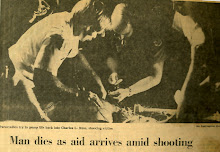
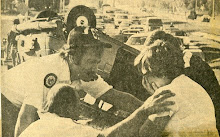
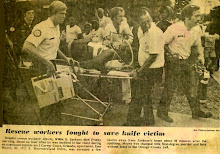
More loud shouting by the cops as we did our assessment. Then we heard gunshots nearby. Still more shouting as the police tried to figure out what was going on and who was shooting at whom. They were not the one firing their weapons. Things were getting very festive at this point. We were frantically trying to get this guy ready for transport so we could get the hell out of there. We got a line, put on the MAST suit, got him on 100% O2 and on a backboard. It took all four of us to lift the backboard onto the stretcher. There was a black and white picture of us the next day in the paper.(See above) We were all black silhouettes framed in the headlights of one of the trucks. We are on our knees bent over the patient trying to start IV’s. The lead to the story was help arriving in the midst of shooting. It is exactly how I remember that scene in black and white silhouettes framed in the headlights. We finally got he patient packed and ready to be transported. It took all four of us to load the patient onto the stretcher. It was time to to get out of there. So we loaded the patient and got him to the hospital. He died in the emergency room. This story is from the early days, around 1977 or 1978. Most of it I wrote at the time it happened. I have left the wording as much intact as I could.
Random Thoughts
These are few of the random thoughts I have written down over the years. I have not changed them since I wrote them over twenty years ago.
The Street is always just below the surface. Scratch me and I bleed a story.
There is a rhythm to the street. After a while you can tell with it is going to be a busy day. (Written on the back of a old set of standing orders sitting in the jump seat of Engine 10 on a busy day I had felt coming).
I’ve had babies die in my arms and some who lived who I wished had died, after the mess we left them in. I’ve had it come out bad so much of the time that I am always surprised and happy when it all works. When everything somehow falls into place. Not much like the TV shows.
It is difficult to understand how something that effects you so profoundly can be thought of as so trivial. That a meeting of the County Commissioners holds more important than what you had seen and what you had gone through and is front page news. While someone's tragic death is buried on page ten.
We make people nervous. When they see our little equipment laden safari moving through their office or a restaurant, they always smile and make some sort of nervous joke about us. As if they the only way to deal with something going wrong is to minimize it. “Nothing serious”, they say as we leave so they can be reassured. And when something does go very wrong they ignore what is going on altogether. I worked a code in a restaurant once. We were in the middle of the floor. People around us continued to eat, as if ignoring what is going on will make it go away.
Friday, April 11, 2008
You Never Know When you Might Make a Difference
I was traveling at the time. Traveling is being used to fill in where ever someone is out sick or on vacation. I was riding with Gary out of Station 6. We got a call to a man cut. Nothing more just a man cut. We arrived to find a well taken care of small middle class home. A mother and a son lived there alone. The son was in his twenties and had a debilitating disease. He was constantly in pain and the disease was slowing eating away at his body and his life. Out of frustration during an argument with his mother he had put his fist through a window. No big deal here just a laceration that I quickly bandaged.
But as I bandaged his wound, Gary and I listened to them talk. He and his mother had been arguing over something trivial and he had exploded. As they talked it became clear that he was angry at his disease and not his mother. Here was a young man in his twenties watching his life slowly being taken from him. He would have no girlfriends. He would not hang out with his buddies at the bar. It would not be long before he would be confined to wheelchair. He could see all of this life around him. He could see the pretty young women. He could see the young men with the life he wanted, but was not going to have and he could do nothing but watch.
As he talked it startled me because for the first time I saw life through eyes of someone who only wanted a simple normal life, yet was never going to have one. To see it so close yet not to be able to have it. I was not sure I would not be putting my fist through windows if I were in his shoes.
Gary and I where old hands at the time. We both were had become paramedics early and had close to fifteen years on at that time. We had survived the busy trucks and were still medics. If we had had this run years before we might have just bandaged the guy up and left. Just a couple of tough guy medics who had their armor on. Nothing got to us. On to the next one. But we had survived that stage and this time without saying a word between us, we began to talk to them. His mother only wanted to help him through his pain. He only had his mother to lash out at in his frustration. He was punishing the only person in the world who was trying to help him.
The son did not want to go to the hospital. Gary and I knew if he went they could see a social worker at the hospital they might be able to help them. I talked to the son and he talked to the mother. After a few minutes we were able to convince the son to let his mother take him to the hospital. They loaded up and drove off. Gary and I got back on the truck and went back to the station. Nothing to it. Just another social work call. Gary and I had been to thousands of them over the years. Not what we were trained to do, nor were we trying or wanting to be social workers. We were just trying to "clean it up" so we would not have to come back. I traveled to another station the next shift day and did not think about it again until Gary called me a few weeks later.
Gary had a call and was returning to the station in the rescue when the mother flagged them down. She was thrilled when she saw it was Gary on the truck. She wanted to thank him for what we had done for them that night. When they went to the hospital they had seen the social worker. They had been referred to a consular and were getting help. She told Gary that we had changed their lives. Her son was more at peace with his disease and no longer had outbursts. She had someone she could talk to her about her own issues with helping her son. They now had someone to help them and it was working.
Changed their lives. That still rings through me when I thing about it. At the time we had both seen enough to be as cynical as anyone. We had seen it all between us, but for whatever the reason that night we put our cynicism aside and simply talked to a couple of people and it changed their lives. You just never know.
Friday, April 4, 2008
The Little Ones
When I remember the street now, I always remember it at night, as if that were the only time there ever was on the street. The only time when things would happen to people, and I would have to pick up the pieces. But not just night, but middle of the night, that 3 in morning time when only the cops, the drunks and us are left to prowl around in some kind of three way dance, the kind of dance that leaves people lying in the gutter bleeding. My partner and I are heading back to the station after the 20th call since we had come on duty at 8 am the morning before. Not one of the calls serious, just another long shift filled with sick lame and lazy. The kind of shift that makes you question why you are a paramedic. Where are the people that need the saving, the world seems to be made up drunks and squirrels who think that calling the fire department will solve almost any real or imagined medical or personal problem.
Just another night on Rescue 1 where your life seems to shift into fast-forward the moment you step on the truck in the morning. The experiences move by so fast, as you race from run to run, you could almost put your hand out the window let it surf through the them as they rush past. Like you did when you were a kid and used to stick your hand out of the window of the car as your parents drove home at night.
With the first run of the morning to the last run you just finished you get the same adrenaline shot each time. So by 3 in the morning the twenty or so adrenaline rushes leaves you exhausted and used up. You lean against the door of the Rescue, feeling as if you did lean against something to prop yourself up, you would fall over and go to sleep. It is as if someone presses the button on your life and the fast forward drops into standard play.
Suddenly in the Florida heat your uniform is damp and sticks you from the constant sweat of driving the streets of a Central Florida town with no air conditioning. Add to the mix lots of left over stress, that combines into this tired buzz, and you have truly unique physical feeling. Your head is fuzzy and aches, your stomach trying to eats it’s way out after the 20 hours on duty and adrenaline rushes have emptied your tank of anything you ate today or yesterday. The only lights are the bronze halogen streetlights that cast an eerie light that is somehow depressing. Your eyes feel as if someone has put a whole sand box under them each time you blink. All you want to do in the world is to lie down and go to sleep for just an uninterrupted hour. Just one silent quite hour. Then through all of the fatigue, physical discomfort and just plain I don’t want to do this the radio in the truck blares.
“Rescue 1 can you take another call.”
You want to run screaming away from that radio to get away from another run, but you pick up the mike and say “Check”.
“Unknown illness to a child. 1492 Paramore.”
“Rescue 1 responding.”
Through all the fatigue you flip on the lights and turn on the siren and head for the address. The box lights reflect off the windows of the stores and buildings of downtown as you head for the wrong side of things. Where you are the doctor to those that do not have the money or insurance for real doctors. It almost seems too melodramatic, red lights flashing on this night as the truck rushes through the empty streets.
When we turned on Amelia and went under the Interstate it was as if we had entered another reality one where you could almost taste the hopelessness, the anger and the frustration of these people who were so close to the money yet so far away. If any sense could capture the feeling of the poverty it was the sense of smell. It is the reek of garbage in all the dimly lit hallways and outside on the dirt yards or the stench of urine in all back upped toilets. Poverty stinks and it can get in your nostrils and under your skin so even when you go home in the morning it ground into your so won’t come out.
We find the address in front of a small two story apartment building. No lights are on, and everything seems locked up tight. We cross the grey dirt strewn with beer cans and trash and walk up to the second story of the apartment on the concrete stairs. When we reach the apartment we each stand on either side of the door. You never stand in front of a door, you never know who is on the other side.
“Fire Department. Did someone call?” I yell as I knock on the door.
A girl immediately opens the door. She is somewhere in her late teens. She is holding a crying baby in her arms. A look of real concern is on her face.
“What seems to be the problem?” I asked.
“He’s running fever and coughing. I..”
She handed me the baby and I looked down at him, I was immediately reminded of my own son at home. He felt exactly the same in my arms. The baby was hot to the touch, but not anymore than my own son the last time he ran a fever. We examined him and it looked as if the worst thing he had was a cold.
“He’s fine. Looks like he has a cold. Do you have any Tylenol? It would make him sleep better tonight and you could take him to the doctor tomorrow?”
“I don’t have any Tylenol?” her voice and the look on her face showed real fear.
The concern and fear in her face let me know that what was really happening as much as anything. Here was a young girl all-alone with her first child and no one to go the drug store to get the Tylenol. She was out on a limb doing the best she could taking care of the baby by herself and had run out of energy dealing with the baby and herself. She needed some help. The apartment was clean and well furnished. It was obvious she was doing a good job no matter what her support system was day to day.
“Look he is going to be fine he just need some Tylenol and some antibiotics. Do you want to go to the hospital with him?”
“What do you think?”
“Yes, I think that would be a good idea. We have an ambulance on the way do you want to go by ambulance?”
“Yes. Yes I do.” the relief on her face was enormous. She just needed someone to help her solve a problem that had gotten too big for her to solve alone.
As I stood there with the crying baby I could feel the relief in her as she gathered things for her diaper bag she would take to the hospital. She had the support she needed, it did not matter that it had came in a red rescue truck, she had someone to ask what to do and then they had the means to solve her problem. Not a big problem in scheme of things, but it was everything to her. When the ambulance arrived we walked her out to the rig and helped her into the back. It was not the type of problem the system was designed to handle, but it was the type of problem we faced daily. I resented these calls back then, because they took so much from you when you so little left in your tank. I was so tired and so ground down I would miss the meaning of them much of the time. But not this time, this time it stuck. No great skill needed or some show off medical decision-making, it took no special training just a willingness to help. It strange because now those are the ones that come to mind first when I think of the street now twenty-six years later.
The little ones that I thought I would forget as the big one piled on top, but its the little ones that come back. Only through years on the Street did I realize that maybe these have as lasting impression as the big ones. There were a lot more of these than the big ones, maybe why this one and the other little one stuck in the memory is the genuine appreciation for the help that was so apparent. With so many of the others the scenes were filled with anger at the system, resentment the of authority you represented, or frightening abdication of personal responsibility for even the most basic human survival skills, it was hard to glean out the fact that they did needed your help. So when these pure crystal clear moments happened they stand out through it all. The street does give back to you, but it buries them under the bad ones, the drunks, and the crazies, so if you are not paying close attention you loose them in all of the bullshit calls.
Wednesday, April 2, 2008
I am Writing this to Remember
I am writing this to remember, to understand, to document things, the things that I did and the things that others did. It is about the war we fought. Not in some far off country but in our hometown. It is about a war that is fought everyday in every hometown by men and women just like me. It is like the Stineyman said one day.
We were at some kind of training, a bunch of paramedics punching out some training requirement ticket between real runs. I don’t remember what the training or how our conversation got on the topic, but Stineyman summed it up best I ever heard. Steiner was a big rambling bear of a man who moved with the grace of a natural athlete. He used to make bets that could out run much smaller and slimmer men at a local track. He usually won. Anyway in the midst of this training he said “we fight death when we come to work.” That was the truth.
We came to work to fight it. To fight it when we were new and young and thought we would save them all. We fought death when we were older, wiser and more experienced and knew we only save a few. We fought death when it did not seem we would ever save anyone again. We fought death when we finally understood that the point was not how many you saved but that you fought the fight. That you went to work and did what you did because that is what mattered and that is all that mattered. You continued the fight because that is what you did. The saving or not saving did not matter as much as showing up and doing it the best you could.
You did it day after day, week after week, month after month, year after year, decade after decade until you looked up and you could see the end of things. Retirement. You could feel the end in your knees as they ached and hurt most days. You feel the end was near in your back where it would hurt in exactly the place it used to kill you after working CPR for a long time. You felt the end in your should where you tore your rotator cup when you dislocated your shoulder years before throwing a ladder. You felt the end was near, when a partner dropped dead of cardiac at home one day after coming home from his second job. You could see the end was near when other guys quit, retired out with injuries, like Larry, Ray or DJ with wires in his back because they could not stop the pain any other way. You knew the end was near when you saw younger men and women come and go long before their time. But the fight continued. You still climbed onto the red trucks and fought the fight. It is a war with no end, no truce, and no sympathy. People continued to die not naturally but stupidly or carelessly and it was up to you to pick up the pieces. To fight the fight.
You finally after decades began to get some perspective, some wisdom from all the pain and suffering. You begin to under stand your role in a lot of the tragedies. It had been what you signed up for all of those many years ago whether you understood it or not. You became part of something few understood. As the end neared you wondered. Wondered if had been a good fight. If it had been worth it. If all that you saw and did really mattered or were like Stineyman in his races running in a circle real fast to show off.
Then you are sitting at a desk one day and it is 9/11. You watch the towers fall. You know that are hundreds of firefighters in those towers and you feel this huge rush of sadness. It had been a huge tragedy when six guys were killed in Massachusetts. This was so much bigger you could not get your mind around it. Maybe a hundred guys. Then you heard the first reports of two hundred guys. Two hundred guys like me. Then three hundred and finally the number reaches 343. Three hundred forty three guys. Jesus. Then the sadness is replaced by pride. Pride to even be in the same profession as these guys. Guys who responded when the bell went off. No other priorities, no other goals. It was their job and they had signed on. To even be a part of a profession that produced such men was suddenly a source of huge pride. They were not extraordinary men, they were ordinary men who did an extraordinary thing. That is what made what they did so significant. Ordinary men called to an extraordinary thing and to a man stepping up and doing it.
They were just firefighters who went to work to fight death. That day they saved thousands as they died. In their death they made you realize just what you and all the others had done. Why the fight was important even in the small tragedies you saw every day. They made you proud of what you had done. They gave to you something that had gotten lost. They gave you understanding.
There were guys on their last shift and they went. They were guys on their first shift and they went. There were guys who called home to tell they families they loved before they went. There were guys who left notes to their families and they went. They went knowing that there was a good chance they were not coming back. They went because it was their job and if you signed up then you did the deed. No raise if you went. No bonuses. They went because they were there to fight death. To fight the fight, no matter what. And because they went they gave back to you something that had been lost, something that you needed back.
We all did it for our own reasons. But to me they gave me back why I had done it. And in so doing they gave back to me the smoking baby, the man with no arms, the drownings, the cardiacs, the accident with injuries, the shootings, the stabbing, the fires and all the rest with perspective. I had done it to fight the fight, day after day, month after month, year after year, decade after decade. No more and no less than that, to be there when someone called. To stand with men and women who no matter what, went when the bell hit. That was something. That mattered. And that is all that mattered.
Monday, March 31, 2008
The Boy Who Went Swimming
The boy was six or seven years old. His eyes were open. He was staring at me. His arms were outstretched and bent at the elbows. It was as if he was going to shout boo to try and scare me, the way you did to your little brother or sister. But he did not say boo. He did not say anything thing. He was underwater.
The call came in as drowning in Station 7’s territory out on the west side of town. Rescue 1 was the only unit with dive gear, divers and the rescue boat. I was the only diver on the truck that day I would have to go into the water.
I jumped into the back of the to dress out as we pulled out of the station. I was tossed from side to side as I tried to get out of my uniform and into swim trunks and the dive gear. It was summer and with no air conditioning in the back of the truck, I was soon dripping sweat in the oppressive Florida summer heat. I struggled into the air tanks shoulder straps, pulled on the weight belt and grabbed my fins and mask. I was ready, but we were still minutes away from the scene. I sat down on the bench seat in the back of the rescue. All I could do now was to wait until we reached the scene.
Engine 7 was already on the scene when we arrived. The lake more correctly an overgrown pond was back in the woods behind some houses. The kind of pond that kids in poor neighborhoods find to cool off on a sweltering Florida summer day.
When I opened the back door to finally get a look at what we had, all I saw were small single story concrete block homes that make up so much of Florida’s poorer neighborhoods. Someone yelled “this way” so I followed them between the homes. I trotted past lawn chairs and chain link fences to reach a well-worn path that lead into the woods behind the houses. The weight of the tank and weight belt began to take its toll as I struggled to keep up the firefighter leading the way.
When we reached the pond we found the guys off Engine 7 were already in the water free diving. I yelled where should I start as I pulled on my fins and mask. They told me somewhere near the middle of the pond. I pulled on my mask and began to swim toward the center of the lake. The water was bathtub warm and the green of most the small lakes in Florida. The visibility was not bad; I could see ten to fifteen feet, for a body of water fed by rainwater runoff that was good. I had been in the water no more than thirty seconds when out of the greenish water those eyes appeared.
I had heard from other guy’s stories of bumping into drowning victims underwater. The face emerging from the gloom and taking them by surprise even though they were looking for them. Those open eyes were so startling. While he did not say boo, he certainly scared me. I grabbed his arm and started swimming toward the shore.
I pulled my mouthpiece out long enough to yell.
“I got him.”
They guys off the engine began to swim to shore with me.
As I swam through the water pulling him behind me I kept thinking of those open eyes. I kept thinking that he looked surprised that I had found him.
I got him to the shore of the shore of the little pond. The guys from Station 7’s rescue were waiting for me. The pulled him out and began to work on him. I pulled off my mask and flippers and stood up. He looked like any other kid in the summer in Florida. All he had on were some shorts. He was in the skinny little boy phase when they are all energy and no muscles yet.
Then I saw his leg. Before I realized what it was. I thought an alligator must have gotten him. One leg was comprised of only his skin over his femur (thigh bone), no muscles, just skin over bone. There was nothing below where his knee should have been. His other legs and arms were normal. Then I realized the skin was intact over the bone, but there were no muscles.
How had a one legged boy gotten to this tiny pond to drown? What string of actions and circumstances had occurred that led someone so obviously incapable of swimming to go swimming? There were no other boys on the scene. In fact we were the only people around. Why did this death have to happen? Did other boys goad him into swimming? Was he trying to prove something to himself or others? I watched as the Engine and Rescue crews worked feverishly over the boy with little success. I walked back to the truck through the peaceful little piece of pinewoods into someone’s back yard. I was tired. I wondered why he had to die. Like so many of the people I worked on, the why was never part of my experience. He was pronounced at the hospital. I never heard the story of why he was in the pond.
Subscribe to:
Posts (Atom)