They took him off life support today. We went to high school together, then it being 1967 he went into the army and I went into the Marines. We both joined the department in the 1970's and retired about the same time. He was one of the first medics. Fought more fire than most. Now he is gone. When the shit was deepest, you would look around and there stood Nick getting it done. He was one of the best. Anyway here's to you Nick, there are damn few of us left.
Showing posts with label firefighter. Show all posts
Showing posts with label firefighter. Show all posts
Monday, October 19, 2009


Monday, September 28, 2009
What Separates Us
A fire station is a unique environment. It is connected to the nervous system of the community it serves. A nervous system that finds every trash fire, car fire, house fire, woman not breathing, child hit my a car, accident with injuries, shooting, stabbing, overdose, difficulty breathing, drowning, cardiac, asthma attack and every other type of personal disaster imaginable. It exists outside the bubble of safety that it helps create for everyone else. When we walk into the station we become part of the nervous system. We become part of all the bad things that happen in our community. We gain knowledge that few outside the station understand exists.
Even if it is not your call, there is this constant litany of emergencies over the radio as other units are dispatched. We stand in the open bay doors and watch children play and ride their bikes in front of the station, while you are listening to units at a shooting on the west side of town. Or you are having breakfast as Engine 6 and Rescue 6 have a woman not breathing. You are cleaning the truck as Engine 2 and Rescue 2 have a stabbing. Then your tones go off and you have your own emergency to manage.
Civilians are the people who live that bubble. That sphere of safety created by us in stations across the city. The bubble where they went to work, ate, slept and played and nobody got hurt or died. Where they felt safe and secure knowing that help is only a phone call away no matter what the emergency. Where they could walk around and not worry about anything except what their own self interest, because when that bubble burst they knew that with a simple phone call we would come and fix whatever was wrong. Our job was to create the bubble and when it burst it was up to us to try to put it back together.
So while we sit in the station in the midst of all of the peace and quite of the neighborhood around us, we are part of this nervous system. We are no longer part of the peaceful world. We are part of the nervous system that can jerk us into the midst of any emergency imaginable. Our job is to create a perceived bubble of safety for our community that protects it no matter what happens. No matter how bad the situation we respond and try and put the pieces back together so people can feel safe again. Can feel protected again. Our job is to try to keep the bubble intact.
When we go to work somebody usually dies, maybe not in fire but in small ways like the auto accident, the drowning, the cardiac, the shooting, the stabbing, or just the end of living a good long life. But somebody died, we live in a world where the unthinkable can and does happen, a world where people die sudden and sometimes ugly deaths. They all had lives and they were over now. Where things are not nice and neat. Where life seems to leave a lot of loose ends. Loose ends that most people only deal with once or twice in a lifetime if they are lucky. These small personal tragedies are our job.
So we enter the real world where actions had terrible consequences. We live with a profound truth that had been lost in our modern society, that death is very near to all of us and it doesn’t take much to cross that line. The great “they” have forgotten it. Modern society seems to try and convince everyone that death is somehow this unusual event. This news-making story of horror. Death is in all our futures in one-way or another. No amount of exercise, diet, drugs or laws will change that ending. Yet in today’s society everyone is so shocked when death does come close.
The nightly news anchors always frown and show concern when they report one of our incidents before moving on to the next story. Secure in the knowledge something so terrible could not happen to them, because they occupy the most protected part of sphere that money, fame and privilege provides. But when it happens to one of them watch their faces. Everything is more real to them. Suddenly it could happen to them and people they know it. But those of us who climb onto the trucks, we have the knowledge. We know how close it is. We think we are smart enough, tough enough and lucky enough to dodge the chances we take on the job long enough to die peacefully in bed.
Because we take that knowledge away from the station, we live with it everyday, it is ground into us. We see life through this new prism. When we walk down the street, go to the beach, go out to eat, we see things that others don’t. We walk in the sphere with the others, but we are always looking for the cracks or leaks that if you are not careful, could make you an accident victim.
We feel separate and apart from those without the knowledge. It is why we spend so many of our off hours with one another. No one else understands. When we tell a story the other guys laugh when they should and shake their heads when they should. It can put up a permanent wall if you let it. This reality pushes you from other people. Friends ask “What happened lately? Do you have any good stories?” But to us, these people are not just stories. They are people who bleed. Who cry. Who die. So you answer “Ah, nothing much happened.” Because when we tell a story if it is for the vicarious thrill of somebody, it diminishes the pain of the victim and our efforts.
What we did is not a story. What we did was a desperate attempt to beat back the inevitable in many cases. But it is our job to try. Certain events stuck in our mind the way signposts draw you attention on the Interstate. They are turning points. Point of reference. Many times they are turning points in our own lives. What we did. What we saw. What we heard. What we tried to do. How we tried to help sometimes can fundamentally change who we are, and how we view the world. And yet none of these events make the headlines. They are the little articles on page two in the local section of the paper, but we carry it around with us each day for the rest of our lives. It separates us from those around us who don't have the knowledge who don't understand. It is the reason that even after thirty years when I see someone I served with we shake hands, smile and ask how they are doing, but there is always a moment that we exchange a glance, a recognition of someone else who knows, who understands, who has the knowledge. The knowing makes us part of a brotherhood. A brotherhood that separates us from those around us and places us the outside the bubble we created.
Thursday, September 17, 2009
Memories
I hear the sirens and air horns now, especially the air horns. Not every time I hear them, but sometimes. Suddenly I am back on the trucks. Pulling on my bunker gear. Looking up a street on the map. Shouldering the straps to my air tank. Pulling up my three quarter boots. Putting on my gloves. I am back in it. I am back on the street. I can almost hear the radio traffic.
“Engine 1, Engine 51, Tower 1, Rescue 1, District 1 house fire….”
“Engine 7, Rescue 7 shooting. OPD is not on the scene….”
“Rescue 1, Rescue Boat 1 respond to assist Engine 7 and Rescue 7 with a drowning….”
“Engine 6, Engine 4,Crash 6, Rescue 6, Tower 1, District 1 plane down…”
“Engine 3, Rescue 3 person not breathing…”
“Engine 10, Tower 10, Rescue 7 District 2 accident with injuries involving entrapment…”
I can almost feel the adrenaline rush. See the red lights of the trucks. Hear the roar of the diesel. Then dispatch would give the report that always meant you had something serious.
“We are receiving multiple calls.”
“We have reports of people trapped.”
“CPR is being performed.”
Then I find myself listening for the reports from the first units to arrive.
“Engine 1 to dispatch we have heavy fire showing from a single story wood frame structure. We are pulling an inch and three quarter line.”
“Engine 6 to Orlando we have a single engine plane down in a tree. No fire. But we do have a fuel leak. Be advised the passenger and the pilot are trapped.”
I am back on the street. That mystical place I named so long ago, the other reality that exists just outside most people’s everyday work a day lives. It is a place that seems to exist in parallel to daily existence. Yet it is only a car accident or cardiac away for everyone.
The street was more than a physical place. It was a place where all of the safe guards end, and my job begin. It is a place filled with excitement, fear, tragedy, horror, sadness, despair, joy, and laughter. It was a place where everyday decisions had terrible consequences. I am going to the grocery store, or I will fix the wiring fixed next month. Where people died or were horribly injured because of these simple daily decisions. It was terrible place, or maybe it is reality. It was where I worked.
The street existed in the poorest homes in Orlando, and in the richest. It existed in back alleys and the main streets. It existed in brush fires, house fires, shooting, stabbings, hangings, cardiac’s, codes, drowning’s, and a thousand other emergencies. It was everywhere. I have houses or intersections that had been scenes and now were signposts in my life. That house is where I pulled the woman out of the fire that afternoon. I pass the intersection where all those people died on that Thanksgiving night when I go to the YMCA. I can see where I had the double shooting from the East/West Expressway. I can see where we tried to save a mother and three children that night in that fire, each time I get on the interstate. Across the street from those apartments is where we found that body that had been undiscovered for three days in the Florida heat. The reminders of the street and the years I spent on it are everywhere around me, like some kind of map of my life. A map that marks life-changing event for me and those I tried to help. Even now, thirty years later, the memories they produce are as strong as ever.
Tuesday, April 15, 2008
It Could Get Festive 2

It was a Friday night and the Saturday Night Specials always came out. It came in as a shooting at Concord and Paramore. Paramore had a liquor store on the corner a block or so north of this address called Liquor World. Our nickname for it was Murder World. Paramore was the center of the rough side of things where desperate people mixed with violent predators in a vicious dance. We were asked to the dance anytime the two connected.
As we neared the scene we were stopped by the police. They told us to hold up that shots were still being fired at the scene and near the scene. They were wide eyed and wired. We fed off their adrenaline as we sat there waiting. Cop cars would race by lights flashing as other officers responded. It was enough to crank up the volume. To get things really humming before we went in. Finally after what seemed an eternity we got the all clear and we were told the scene was safe and to go on in.
We drove the short few blocks and bailed out of the truck. When we arrived to find to find a single victim. A huge male illuminated in the flashlights of several cops. In the hard light of the flashlights and our headlights the whole scene looked like a black and white picture.
The victim was large enough that he looked like a professional football lineman, he had a single .22 caliber gunshot wound to the left chest.
The scene was chaotic. Police were running around with their guns drawn and eyes wide shouting at someone down the street. The ambulance had arrived with us and the four of us got right to work. He had no perceptible pulse but his heart still showed a rhythm.
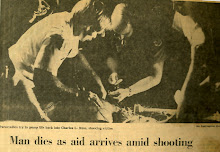
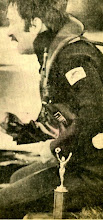
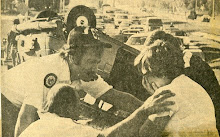
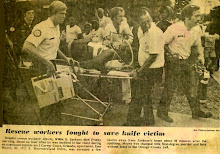
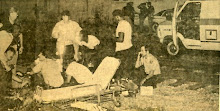
More loud shouting by the cops as we did our assessment. Then we heard gunshots nearby. Still more shouting as the police tried to figure out what was going on and who was shooting at whom. They were not the one firing their weapons. Things were getting very festive at this point. We were frantically trying to get this guy ready for transport so we could get the hell out of there. We got a line, put on the MAST suit, got him on 100% O2 and on a backboard. It took all four of us to lift the backboard onto the stretcher. There was a black and white picture of us the next day in the paper.(See above) We were all black silhouettes framed in the headlights of one of the trucks. We are on our knees bent over the patient trying to start IV’s. The lead to the story was help arriving in the midst of shooting. It is exactly how I remember that scene in black and white silhouettes framed in the headlights. We finally got he patient packed and ready to be transported. It took all four of us to load the patient onto the stretcher. It was time to to get out of there. So we loaded the patient and got him to the hospital. He died in the emergency room. This story is from the early days, around 1977 or 1978. Most of it I wrote at the time it happened. I have left the wording as much intact as I could.
Random Thoughts
These are few of the random thoughts I have written down over the years. I have not changed them since I wrote them over twenty years ago.
The Street is always just below the surface. Scratch me and I bleed a story.
There is a rhythm to the street. After a while you can tell with it is going to be a busy day. (Written on the back of a old set of standing orders sitting in the jump seat of Engine 10 on a busy day I had felt coming).
I’ve had babies die in my arms and some who lived who I wished had died, after the mess we left them in. I’ve had it come out bad so much of the time that I am always surprised and happy when it all works. When everything somehow falls into place. Not much like the TV shows.
It is difficult to understand how something that effects you so profoundly can be thought of as so trivial. That a meeting of the County Commissioners holds more important than what you had seen and what you had gone through and is front page news. While someone's tragic death is buried on page ten.
We make people nervous. When they see our little equipment laden safari moving through their office or a restaurant, they always smile and make some sort of nervous joke about us. As if they the only way to deal with something going wrong is to minimize it. “Nothing serious”, they say as we leave so they can be reassured. And when something does go very wrong they ignore what is going on altogether. I worked a code in a restaurant once. We were in the middle of the floor. People around us continued to eat, as if ignoring what is going on will make it go away.
Friday, April 11, 2008
You Never Know When you Might Make a Difference
I was traveling at the time. Traveling is being used to fill in where ever someone is out sick or on vacation. I was riding with Gary out of Station 6. We got a call to a man cut. Nothing more just a man cut. We arrived to find a well taken care of small middle class home. A mother and a son lived there alone. The son was in his twenties and had a debilitating disease. He was constantly in pain and the disease was slowing eating away at his body and his life. Out of frustration during an argument with his mother he had put his fist through a window. No big deal here just a laceration that I quickly bandaged.
But as I bandaged his wound, Gary and I listened to them talk. He and his mother had been arguing over something trivial and he had exploded. As they talked it became clear that he was angry at his disease and not his mother. Here was a young man in his twenties watching his life slowly being taken from him. He would have no girlfriends. He would not hang out with his buddies at the bar. It would not be long before he would be confined to wheelchair. He could see all of this life around him. He could see the pretty young women. He could see the young men with the life he wanted, but was not going to have and he could do nothing but watch.
As he talked it startled me because for the first time I saw life through eyes of someone who only wanted a simple normal life, yet was never going to have one. To see it so close yet not to be able to have it. I was not sure I would not be putting my fist through windows if I were in his shoes.
Gary and I where old hands at the time. We both were had become paramedics early and had close to fifteen years on at that time. We had survived the busy trucks and were still medics. If we had had this run years before we might have just bandaged the guy up and left. Just a couple of tough guy medics who had their armor on. Nothing got to us. On to the next one. But we had survived that stage and this time without saying a word between us, we began to talk to them. His mother only wanted to help him through his pain. He only had his mother to lash out at in his frustration. He was punishing the only person in the world who was trying to help him.
The son did not want to go to the hospital. Gary and I knew if he went they could see a social worker at the hospital they might be able to help them. I talked to the son and he talked to the mother. After a few minutes we were able to convince the son to let his mother take him to the hospital. They loaded up and drove off. Gary and I got back on the truck and went back to the station. Nothing to it. Just another social work call. Gary and I had been to thousands of them over the years. Not what we were trained to do, nor were we trying or wanting to be social workers. We were just trying to "clean it up" so we would not have to come back. I traveled to another station the next shift day and did not think about it again until Gary called me a few weeks later.
Gary had a call and was returning to the station in the rescue when the mother flagged them down. She was thrilled when she saw it was Gary on the truck. She wanted to thank him for what we had done for them that night. When they went to the hospital they had seen the social worker. They had been referred to a consular and were getting help. She told Gary that we had changed their lives. Her son was more at peace with his disease and no longer had outbursts. She had someone she could talk to her about her own issues with helping her son. They now had someone to help them and it was working.
Changed their lives. That still rings through me when I thing about it. At the time we had both seen enough to be as cynical as anyone. We had seen it all between us, but for whatever the reason that night we put our cynicism aside and simply talked to a couple of people and it changed their lives. You just never know.
Friday, April 4, 2008
The Little Ones
When I remember the street now, I always remember it at night, as if that were the only time there ever was on the street. The only time when things would happen to people, and I would have to pick up the pieces. But not just night, but middle of the night, that 3 in morning time when only the cops, the drunks and us are left to prowl around in some kind of three way dance, the kind of dance that leaves people lying in the gutter bleeding. My partner and I are heading back to the station after the 20th call since we had come on duty at 8 am the morning before. Not one of the calls serious, just another long shift filled with sick lame and lazy. The kind of shift that makes you question why you are a paramedic. Where are the people that need the saving, the world seems to be made up drunks and squirrels who think that calling the fire department will solve almost any real or imagined medical or personal problem.
Just another night on Rescue 1 where your life seems to shift into fast-forward the moment you step on the truck in the morning. The experiences move by so fast, as you race from run to run, you could almost put your hand out the window let it surf through the them as they rush past. Like you did when you were a kid and used to stick your hand out of the window of the car as your parents drove home at night.
With the first run of the morning to the last run you just finished you get the same adrenaline shot each time. So by 3 in the morning the twenty or so adrenaline rushes leaves you exhausted and used up. You lean against the door of the Rescue, feeling as if you did lean against something to prop yourself up, you would fall over and go to sleep. It is as if someone presses the button on your life and the fast forward drops into standard play.
Suddenly in the Florida heat your uniform is damp and sticks you from the constant sweat of driving the streets of a Central Florida town with no air conditioning. Add to the mix lots of left over stress, that combines into this tired buzz, and you have truly unique physical feeling. Your head is fuzzy and aches, your stomach trying to eats it’s way out after the 20 hours on duty and adrenaline rushes have emptied your tank of anything you ate today or yesterday. The only lights are the bronze halogen streetlights that cast an eerie light that is somehow depressing. Your eyes feel as if someone has put a whole sand box under them each time you blink. All you want to do in the world is to lie down and go to sleep for just an uninterrupted hour. Just one silent quite hour. Then through all of the fatigue, physical discomfort and just plain I don’t want to do this the radio in the truck blares.
“Rescue 1 can you take another call.”
You want to run screaming away from that radio to get away from another run, but you pick up the mike and say “Check”.
“Unknown illness to a child. 1492 Paramore.”
“Rescue 1 responding.”
Through all the fatigue you flip on the lights and turn on the siren and head for the address. The box lights reflect off the windows of the stores and buildings of downtown as you head for the wrong side of things. Where you are the doctor to those that do not have the money or insurance for real doctors. It almost seems too melodramatic, red lights flashing on this night as the truck rushes through the empty streets.
When we turned on Amelia and went under the Interstate it was as if we had entered another reality one where you could almost taste the hopelessness, the anger and the frustration of these people who were so close to the money yet so far away. If any sense could capture the feeling of the poverty it was the sense of smell. It is the reek of garbage in all the dimly lit hallways and outside on the dirt yards or the stench of urine in all back upped toilets. Poverty stinks and it can get in your nostrils and under your skin so even when you go home in the morning it ground into your so won’t come out.
We find the address in front of a small two story apartment building. No lights are on, and everything seems locked up tight. We cross the grey dirt strewn with beer cans and trash and walk up to the second story of the apartment on the concrete stairs. When we reach the apartment we each stand on either side of the door. You never stand in front of a door, you never know who is on the other side.
“Fire Department. Did someone call?” I yell as I knock on the door.
A girl immediately opens the door. She is somewhere in her late teens. She is holding a crying baby in her arms. A look of real concern is on her face.
“What seems to be the problem?” I asked.
“He’s running fever and coughing. I..”
She handed me the baby and I looked down at him, I was immediately reminded of my own son at home. He felt exactly the same in my arms. The baby was hot to the touch, but not anymore than my own son the last time he ran a fever. We examined him and it looked as if the worst thing he had was a cold.
“He’s fine. Looks like he has a cold. Do you have any Tylenol? It would make him sleep better tonight and you could take him to the doctor tomorrow?”
“I don’t have any Tylenol?” her voice and the look on her face showed real fear.
The concern and fear in her face let me know that what was really happening as much as anything. Here was a young girl all-alone with her first child and no one to go the drug store to get the Tylenol. She was out on a limb doing the best she could taking care of the baby by herself and had run out of energy dealing with the baby and herself. She needed some help. The apartment was clean and well furnished. It was obvious she was doing a good job no matter what her support system was day to day.
“Look he is going to be fine he just need some Tylenol and some antibiotics. Do you want to go to the hospital with him?”
“What do you think?”
“Yes, I think that would be a good idea. We have an ambulance on the way do you want to go by ambulance?”
“Yes. Yes I do.” the relief on her face was enormous. She just needed someone to help her solve a problem that had gotten too big for her to solve alone.
As I stood there with the crying baby I could feel the relief in her as she gathered things for her diaper bag she would take to the hospital. She had the support she needed, it did not matter that it had came in a red rescue truck, she had someone to ask what to do and then they had the means to solve her problem. Not a big problem in scheme of things, but it was everything to her. When the ambulance arrived we walked her out to the rig and helped her into the back. It was not the type of problem the system was designed to handle, but it was the type of problem we faced daily. I resented these calls back then, because they took so much from you when you so little left in your tank. I was so tired and so ground down I would miss the meaning of them much of the time. But not this time, this time it stuck. No great skill needed or some show off medical decision-making, it took no special training just a willingness to help. It strange because now those are the ones that come to mind first when I think of the street now twenty-six years later.
The little ones that I thought I would forget as the big one piled on top, but its the little ones that come back. Only through years on the Street did I realize that maybe these have as lasting impression as the big ones. There were a lot more of these than the big ones, maybe why this one and the other little one stuck in the memory is the genuine appreciation for the help that was so apparent. With so many of the others the scenes were filled with anger at the system, resentment the of authority you represented, or frightening abdication of personal responsibility for even the most basic human survival skills, it was hard to glean out the fact that they did needed your help. So when these pure crystal clear moments happened they stand out through it all. The street does give back to you, but it buries them under the bad ones, the drunks, and the crazies, so if you are not paying close attention you loose them in all of the bullshit calls.
Wednesday, April 2, 2008
I am Writing this to Remember
I am writing this to remember, to understand, to document things, the things that I did and the things that others did. It is about the war we fought. Not in some far off country but in our hometown. It is about a war that is fought everyday in every hometown by men and women just like me. It is like the Stineyman said one day.
We were at some kind of training, a bunch of paramedics punching out some training requirement ticket between real runs. I don’t remember what the training or how our conversation got on the topic, but Stineyman summed it up best I ever heard. Steiner was a big rambling bear of a man who moved with the grace of a natural athlete. He used to make bets that could out run much smaller and slimmer men at a local track. He usually won. Anyway in the midst of this training he said “we fight death when we come to work.” That was the truth.
We came to work to fight it. To fight it when we were new and young and thought we would save them all. We fought death when we were older, wiser and more experienced and knew we only save a few. We fought death when it did not seem we would ever save anyone again. We fought death when we finally understood that the point was not how many you saved but that you fought the fight. That you went to work and did what you did because that is what mattered and that is all that mattered. You continued the fight because that is what you did. The saving or not saving did not matter as much as showing up and doing it the best you could.
You did it day after day, week after week, month after month, year after year, decade after decade until you looked up and you could see the end of things. Retirement. You could feel the end in your knees as they ached and hurt most days. You feel the end was near in your back where it would hurt in exactly the place it used to kill you after working CPR for a long time. You felt the end in your should where you tore your rotator cup when you dislocated your shoulder years before throwing a ladder. You felt the end was near, when a partner dropped dead of cardiac at home one day after coming home from his second job. You could see the end was near when other guys quit, retired out with injuries, like Larry, Ray or DJ with wires in his back because they could not stop the pain any other way. You knew the end was near when you saw younger men and women come and go long before their time. But the fight continued. You still climbed onto the red trucks and fought the fight. It is a war with no end, no truce, and no sympathy. People continued to die not naturally but stupidly or carelessly and it was up to you to pick up the pieces. To fight the fight.
You finally after decades began to get some perspective, some wisdom from all the pain and suffering. You begin to under stand your role in a lot of the tragedies. It had been what you signed up for all of those many years ago whether you understood it or not. You became part of something few understood. As the end neared you wondered. Wondered if had been a good fight. If it had been worth it. If all that you saw and did really mattered or were like Stineyman in his races running in a circle real fast to show off.
Then you are sitting at a desk one day and it is 9/11. You watch the towers fall. You know that are hundreds of firefighters in those towers and you feel this huge rush of sadness. It had been a huge tragedy when six guys were killed in Massachusetts. This was so much bigger you could not get your mind around it. Maybe a hundred guys. Then you heard the first reports of two hundred guys. Two hundred guys like me. Then three hundred and finally the number reaches 343. Three hundred forty three guys. Jesus. Then the sadness is replaced by pride. Pride to even be in the same profession as these guys. Guys who responded when the bell went off. No other priorities, no other goals. It was their job and they had signed on. To even be a part of a profession that produced such men was suddenly a source of huge pride. They were not extraordinary men, they were ordinary men who did an extraordinary thing. That is what made what they did so significant. Ordinary men called to an extraordinary thing and to a man stepping up and doing it.
They were just firefighters who went to work to fight death. That day they saved thousands as they died. In their death they made you realize just what you and all the others had done. Why the fight was important even in the small tragedies you saw every day. They made you proud of what you had done. They gave to you something that had gotten lost. They gave you understanding.
There were guys on their last shift and they went. They were guys on their first shift and they went. There were guys who called home to tell they families they loved before they went. There were guys who left notes to their families and they went. They went knowing that there was a good chance they were not coming back. They went because it was their job and if you signed up then you did the deed. No raise if you went. No bonuses. They went because they were there to fight death. To fight the fight, no matter what. And because they went they gave back to you something that had been lost, something that you needed back.
We all did it for our own reasons. But to me they gave me back why I had done it. And in so doing they gave back to me the smoking baby, the man with no arms, the drownings, the cardiacs, the accident with injuries, the shootings, the stabbing, the fires and all the rest with perspective. I had done it to fight the fight, day after day, month after month, year after year, decade after decade. No more and no less than that, to be there when someone called. To stand with men and women who no matter what, went when the bell hit. That was something. That mattered. And that is all that mattered.
Monday, March 31, 2008
The Boy Who Went Swimming
The boy was six or seven years old. His eyes were open. He was staring at me. His arms were outstretched and bent at the elbows. It was as if he was going to shout boo to try and scare me, the way you did to your little brother or sister. But he did not say boo. He did not say anything thing. He was underwater.
The call came in as drowning in Station 7’s territory out on the west side of town. Rescue 1 was the only unit with dive gear, divers and the rescue boat. I was the only diver on the truck that day I would have to go into the water.
I jumped into the back of the to dress out as we pulled out of the station. I was tossed from side to side as I tried to get out of my uniform and into swim trunks and the dive gear. It was summer and with no air conditioning in the back of the truck, I was soon dripping sweat in the oppressive Florida summer heat. I struggled into the air tanks shoulder straps, pulled on the weight belt and grabbed my fins and mask. I was ready, but we were still minutes away from the scene. I sat down on the bench seat in the back of the rescue. All I could do now was to wait until we reached the scene.
Engine 7 was already on the scene when we arrived. The lake more correctly an overgrown pond was back in the woods behind some houses. The kind of pond that kids in poor neighborhoods find to cool off on a sweltering Florida summer day.
When I opened the back door to finally get a look at what we had, all I saw were small single story concrete block homes that make up so much of Florida’s poorer neighborhoods. Someone yelled “this way” so I followed them between the homes. I trotted past lawn chairs and chain link fences to reach a well-worn path that lead into the woods behind the houses. The weight of the tank and weight belt began to take its toll as I struggled to keep up the firefighter leading the way.
When we reached the pond we found the guys off Engine 7 were already in the water free diving. I yelled where should I start as I pulled on my fins and mask. They told me somewhere near the middle of the pond. I pulled on my mask and began to swim toward the center of the lake. The water was bathtub warm and the green of most the small lakes in Florida. The visibility was not bad; I could see ten to fifteen feet, for a body of water fed by rainwater runoff that was good. I had been in the water no more than thirty seconds when out of the greenish water those eyes appeared.
I had heard from other guy’s stories of bumping into drowning victims underwater. The face emerging from the gloom and taking them by surprise even though they were looking for them. Those open eyes were so startling. While he did not say boo, he certainly scared me. I grabbed his arm and started swimming toward the shore.
I pulled my mouthpiece out long enough to yell.
“I got him.”
They guys off the engine began to swim to shore with me.
As I swam through the water pulling him behind me I kept thinking of those open eyes. I kept thinking that he looked surprised that I had found him.
I got him to the shore of the shore of the little pond. The guys from Station 7’s rescue were waiting for me. The pulled him out and began to work on him. I pulled off my mask and flippers and stood up. He looked like any other kid in the summer in Florida. All he had on were some shorts. He was in the skinny little boy phase when they are all energy and no muscles yet.
Then I saw his leg. Before I realized what it was. I thought an alligator must have gotten him. One leg was comprised of only his skin over his femur (thigh bone), no muscles, just skin over bone. There was nothing below where his knee should have been. His other legs and arms were normal. Then I realized the skin was intact over the bone, but there were no muscles.
How had a one legged boy gotten to this tiny pond to drown? What string of actions and circumstances had occurred that led someone so obviously incapable of swimming to go swimming? There were no other boys on the scene. In fact we were the only people around. Why did this death have to happen? Did other boys goad him into swimming? Was he trying to prove something to himself or others? I watched as the Engine and Rescue crews worked feverishly over the boy with little success. I walked back to the truck through the peaceful little piece of pinewoods into someone’s back yard. I was tired. I wondered why he had to die. Like so many of the people I worked on, the why was never part of my experience. He was pronounced at the hospital. I never heard the story of why he was in the pond.
She Done Fell Out
The call came in as a woman down. There was no more information. We arrived on the scene to find a small house set well back from the street. The only light came from the open door framing a man standing in the doorway.
“Hurry, hurry.” He shouted. “She done fell out.”
We had an extra guy riding with us on the rescue that night. So I was able to head to the house as the other two got the equipment. I felt nervous walking into the darkness alone, but it had come in as a woman down and not as a scene of violence. When I walked in the front door and past the frantic man, I found a woman in her twenties sprawled across a couch. Frank blood was pouring from her nose and mouth. She was not breathing and she had not pulse.
“I don’t know what happened to her. She just done fell out.” The man said. He kept repeating the phrase as if he were practicing it, as he moved around the room very agitated.
The other two guys off the rescue arrived as I pulled the woman onto the floor so we could work on her. I could not figure out what was causing this kind of bleeding. But she was coded and we knew what we had to do. I got on the radio and requested an Engine to assist with manpower. My partner started to tube her as the third guy off the truck started compressions.
Her face was covered with blood, but I thought I saw something on her cheek. I stopped looking for an IV site long enough to wipe her cheek off with a 4x4. There was a bullet hole that had been covered with coagulated blood.
The guy was walking a couple of feet behind us muttering. “I don’t know what happened she just fell out.”
That is when I got real nervous. I made the wild guess that this was probably the guy who had given her this bullet hole that made her “fall out”.
I got on the radio and said.
“Rescue 1 to dispatch we need code 8 (police) on the scene.”
“Check can you advise the nature of the request?”
Now here was this guy who was more than likely shot this woman, pacing the floor three feet in back of us, and the dispatchers wants to know why we need the police. I try and whisper so he won’t hear me.
“Possible homicide.”
“Check.” Her replay blares over all our radios. “Possible homicide.”
I wanted to crawl under the coach. I waited for this guy to go nuts. But he just keeps pacing and muttering. The Engine company arrives, followed closely by the cops. I am feeling safer now with all the company. Soon the ambulance arrives and still more cops. The small house is filled with first responders. The guy keeps muttering.
“I don’t know what happened she just feel out.”
The guys off the engine knew the neighborhood and took one look at the patient and began to look for a weapon without saying a word. The guys off Engine 2 were experienced hands who went to scenes of violence with us regularly. They no more wanted to get caught in the middle of a gunfight between the suspect and the cops than we did.
Finally one of the cops asked the Engine guys.
“You find a weapon?”
“We looked for a weapon but could not find one.”
Our guy suddenly stopped pacing and looks up and says.
“Gun what gun.”
Well since no one had even so much as mentioned a shooting or a gun or even what we suspected had happened to the victim, this statement came as something of a revelation to say the least. The room got kind of quite for minute as everyone looked at the guy. The firefighters got busy again working on the patient, while the cops suddenly showed a lot of interest in our little guy.
We loaded our patient and transported her to the hospital. It turned out that the bullet had splintered as soon as it had entered her cheek and severed both her carotid arteries and jugular veins. She was dead the minute he shot her.
I read about his trial months later in the paper. He was convicted of her murder and sentenced to life in prison. It turned out that he had shot her once before, and spent time in prison for the crime. When he was released and she had let him back into her life.
Sunday, March 30, 2008
Crack Baby
When we turned onto Barlow, it was as if we had made right turn to the mean side of things. The side where baby’s are born in the dark, with little joy or hope. Where the father lies passed out on the couch. And the mother cries through her agony alone. It can take much of the joy of a birth away, but never completely. It is too much of a new life beginning with all that can mean. The date of birth was 4/28/88 at 2311. It was a small concrete block dark house with no rugs on the concrete floors, and no air conditioning on a short sandy dirt road. There had been a murder on this same street just recently. The front door was wide open. There was no one there to greet us and there were no lights on in the house. Jeff and I approached the door cautiously.
“Fire department!” I said.
“In here.” A female voice yelled.
We found a woman laying on a dirty double bed with the phone lying beside her. There was no other furniture in the room. Only a black light like those used in the sixties light the room.
“He came. He already came. Is he all right?” she said.
She still had her shorts and panties on, but there was a large bulge visible. As Jeff and I cut her shorts and panties off we questioned her.
“How many babies that lived have you had?”
“Six. The doctor said this one was late. May or June. I thought it was late April or May. Is he all right?”
When we had cut off her shorts and panties we could see the baby. He was so small. Almost too small to be believe he was a real baby. He looked like a crack baby. A full term baby that weighed less that three pounds. The umbilical cord still ran back into the mother.
The baby was not breathing. Jeff started to clean the baby off hoping to stimulate his breathing. Nothing. He began thumbing his finger on the soles of his tiny feet to get him breathing.
I dove into the emergency childbirth kit. Actually a very fancy word for a cardboard box with a bag for sterile gloves, paper sheets, bulb syringe, umbilical clamps, scalpel and paper blankets. I tore open the bag and handed him the bulb syringe so he could suction out the baby’s mouth.
Next I dug for the two clamps for the umbilical cord. You place two clamps on the cord and cut in the middle. Six inches from the vagina you place the first clamp, then two inches and you place the second. The clamps keep the mother and baby from bleeding out after the cord is cut. They both have large blood vessels within the cord. It is how the baby is supplied with blood, oxygen and nourishment during gestation. If you just cut it without a clamping it with two clamps you would lose both the baby and the mother. But I could only find one clamp. One clamp. How is world do I end up with the only kit in the world with only one clamp?
Jeff was working frantically to stimulate the little boy to breath, but was till having no luck.
The only light in the bedroom was a black light, a black light why were these births always in the dark. The black light made my hunt for the second clamp in the kit even more difficult. Jeff and I are holding our mini-mag flashlights in our mouths to keep our hands free. So was we talked our words a jumbled around the flashlights. If it was such a serious situation it would have been very funny.
“He is not trying to breath we need to get that cord cut.” Jeff says.
A baby will not try and breath on their on, as long as they remain attached by the umbilical cord. We needed to cut the cord to stimulate the baby’s breathing.
“I can’t find the other clamp.”
“Great!”
The engine company who had been dispatched with us has just arrived.
“We need another child birth kit.”
One of the firefighters turns and runs out to the engine to get the other kit. Jeff continues stimulating the baby thumping his finger repeatedly on the soles of the baby’s feet. He is starting to respond to Jeff’s stimulation. He has a good heartbeat but he is still not breathing well. The firefighter runs back into the room and hands me another kit. I tear it open and find a second clamp.
“Six inches from the baby.” I recite to myself.
I place the clamp.
“Two more inches.”
I place the second clamp.
I tear open the package containing the sterile scalpel and cut the cord between the two clamps. Blood flies everywhere. Suddenly I am very aware of the blood. The mother is obviously someone with the types of behaviors that could lead to AIDS. Now I am going to have to worry about an AIDS exposure if I am not careful, even with our gloves and goggles on. But there is no excessive bleeding. Good then the clamps worked.
Once the cord was cut the baby begins to try to breath, but he not moving much air.
“We are going to have to try and tube him.” Jeff says.
He grabs the lyrnascope, and a pediatric blade. I pull out a pediatric tube and compare its size against the baby’s little finger. That is the rule of thumb for the size he will need. It takes the smallest tube we have. Jeff tries to insert the blade into the baby’s mouth.
“He trying to bite the blade.”
Jeff reapplies the oxygen and again stimulates the baby by thumping the soles of his feet with his finger, the baby’s breathing gets much better. He pinks up nicely, showing he is oxygenating well. His color finally begins to look normal.
It is time to run for the hospital before any more problems crop up. But the ambulance still has not arrived.
“Rescue 7 to Dispatch can you give me an ETA for the ambulance.”
“Rescue 7 check standby.”
We begin to package up the mother and baby to get them ready for transportation when the ambulance gets there.
“Dispatch to Rescue 7 they are advising a six minute ETA.”
Jeff and I look at each other. Without a word passing between us we know that could mean a lot more time than six minutes. We do not want to wait that long.
“We going to have to transport.” I said.
“Yeah.”
Jeff is busy with the baby. So I grab a guy off the engine and we go out to the rescue. While we can transport a patient, but the rig is not ready. We have our fire gear on the floor in addition to other gear on the stretcher. I pulled the Thumper, an automatic CPR device and throw it on the bench seat. I pulled the backboard off the stretcher and cram it on the floor. I jam our firefighters bunker coats, pants and boots into the corner. I can finally pull the stretcher out of the back of the rig.
The firefighter and I are able to get the stretcher into the tiny apartment, but we could not make the turn into the bedroom. The father is finally starting to wake up with all of the commotion around him. He sits up groggily on the couch. We run over his bare feet with the stretcher, but he says nothing as he sits rubbing his eyes.
Jeff has wrapped the baby in everything the kit carries to keep him warm. The bundle seems too tiny to even be a doll much less a real baby. We load the mother onto the stretcher and struggle past the still groggy father. He says nothing as we leave with the mother and the baby.
I jump in the front of the rescue and Jeff jumps in the back with the baby and the mother. One of the firefighters off the engine jumps in the back to assist Jeff on the ride to the hospital.
I the radioed the hospital that we were en-route and what we had what appeared to be a crack baby. It was silent ride to the hospital and the mother rested and Jeff monitored the baby. When we pulled into the portico and unloaded the stretcher a physician and nurses from the pediatric intensive care waiting for us. We handed the mother and the tiny baby over to the waiting team. They rushed them into the emergency department.
We followed the team into the hospital. Walking into the emergency department was a startling contrast to the dark black light lit dirty apartment. It was a bright modern hospital with all of the best equipment and trained personnel waiting for the baby. We had jerked him from the poverty and hopelessness and thrown him into a high tech world waiting to try and save him so he could go back to the dirty black light lit apartment.
Jeff and I stood there watching as they work on this tiny human baby whose life was just begining. He turned out to be a crack baby, full term yet weighing only two and half pounds. Mom was a crack addict. Despite the circumstances I still felt a sense of joy at a new life starting, but it was colored by the realization of just what kind of life he was going to face.
Jeff and I watch them work on him for a while, then did our paper work. We re-stocked our supplies and went out to the rescue to put it back together for the next run. We had several more before we got off duty the next morning. I never check on him or how he did. I had learned the hard way over the years that did not always lead to any good answers. I still think about him and it has been almost exactly twenty years as I write this. I wonder how his life turned out.
Tuesday, March 25, 2008
My Felony Arrest
Charlie and I had just finished a run at one of the shopping malls. We were driving away from the mall, when two men suddenly burst out of a store. Their arms are piled high with suits. Two store personnel follow closely yelling and gesturing wildly. Apparently those two guys were trying to get away with a snatch and grab, but there was no getaway car in sight. So these guys were trying to do a world record sprint with 25 suits in their arms. They are leaving the store employees in their dust when they look up and see us and the rescue truck.
Once they see us they throw away the suits, and take off across the parking lot. Now my partner and I aren’t quite sure what to do. I finally said “follow those guys.”
So we turned on the light and sirens and started to follow these guys across the parking lot. I got on the radio and advised the dispatcher we were in pursuit of two possible robbery suspects and we needed law enforcement as soon as possible before we caught these guys. What were we going to do with them once we caught them?
You have got to picture a large rescue truck with two guys sitting in air conditioned comfort chasing/following two guys frantically trying to out run the truck. These two guys kept looking over their shoulders as if to say “What in the fuck is going on? We can’t even do a simple rip off right.”
We continued to follow these guys as they ran across the parking lot and around a bowling alley, where they finally stopped exhausted. Now the worst happened. They stopped. Now what. The cops were still not there.
Charlie and I jump out and stand by the truck. The guys were about thirty feet away. I thought that was close enough. So I gave them my best police officer pose, hands on hips, leave my sunglasses on and try to look tough.
“All right now you guys just stay right there. The cops will be here any minute.”
Well these guys start to catch their breath. The begin to realize that here are two dummies with nothing but radios and paramedic scissors on their belts telling them to wait so they can be arrested and carted off to jail. This does not seem like a very good idea to one of them. He takes off running.
I figure one out of two ain’t bad for two unarmed paramedics. I am satisfied. But Charlie is off like a flash and grabs this guy and throws him back with his partner. I cringed, Jeeze Charlie don’t make him mad.
“Now stay put.” Charlie yells.
They look at one another then at us. You could see them trying to decide if they were going to stand for this. I mean two paramedics, who is afraid of a paramedic.
But before they could come to a decision a cop coming rolling up and jumps out of the car. If you think the looks the robbers were strange. you should have seen the look this cop gives us as he pats down the suspects.
When we pulled into the station we into the station the word had already gotten out. We got a hard time about trying to be cops for a long time. There was even a cartoon in the department newsletter. It showed Charlie grabbing the guy while I stood with my hands in my pockets. The caption was “count me out.” I was known for sometime as Count Me Out Huder.
O2 and Transport
We received a call one night for a miscarriage. The addressed turned out to be a dilapidated rental house in a poor section of town. We found a sixteen-year-old girl lying in a huge pool of blood. A single bare light bulb illuminated the scene. She lay in this rectangle of harsh white light, her blood black in the light. It was as if someone had staged a stark black and white picture of the life that led up to this. A tiny fetus still attached to the umbilical cord that lay between her legs. She laid half in and half out of the tiny bathroom.
She was only dimly conscious. Her pulse was barely discernable and I was only able to palpate a blood pressure. I immediately got on the radio. We were going to need orders if we were going to do any good for this girl. We needed orders to start any type of advanced life support and that is exactly what she needed. I talked to medical communications and they got me through to the hospital.
“This is paramedic Huder number 104. We have a sixteen-year-old patient who aborted an approximately two-month fetus. She is conscious, cool and diaphoretic to the touch. The patient has lost approximately 1000cc’s of blood and is still bleeding frank blood from her vagina. The fetus is still attached to the umbilical cord appears to be attached to the uterus.
Blood pressure is 50 palpable, her pulse is 120. We have her on six liters of O2. I would like permission to start 2 IV’s of lactated ringers before transport to your facility.”
I waited for the hospital to reply. This was the type of call I had become a paramedic. We could help. We could make a difference. She needed fluid replacement. It would help stabilize her before we got her to the hospital. Every second counted.
“Standby.” The voice on the radio said.
Standby what in the hell do I need to standby for, just give me the order and lets get this show on the road.
“ Rescue 1. Place your patient on O2 and transport immediately.”
“ Repeat.” I couldn’t believe it.
“Place your patient on O2 and transport immediately.”
My partner and I just looked at each other. The wrong doctor was on duty. He never gave orders. We called him O2 and transport. Now he was pulling his shit on this little girl.
What in the hell was I out here for? Why had I gone through all the training? Why was putting up with all the shit from the other firefighters. If we were not going to be able to do the job, then lets stop playing around with people’s lives. I never knew if or what kind of orders I would get when I called the hospital, but this…
My partner and I carefully loaded her up as quickly as possible into the ambulance when it arrived. It was a silent ride into the hospital. All we could do was hold her hand and try to say a few comforting words and wonder why we were out on the street.
A few minutes later the ambulance pulled under the overhang at the hospital. We carefully unloaded her and rushed her into the room where the nurses directed us. We stood there alone with the girl for several minutes. We had not been guided into the trauma room, but instead we had been shown into a normal room. There was no team waiting for us.
A nurse finally walked in and took one look at our patient and us. She immediately turned and rushed off to find the doctor. Apparently they had not believed our radio report. After all we were just paramedics. When he arrived he immediately ordered two IV’s and called for the trauma team.
Still the same
I have discovered the EMS blogging world in the last weeks. I have read a number of the blogs. There are new medic blogs, old medic blogs, funny blogs and sad blogs. All the stories, all the concerns and challenges they face every shift. It is as if I wrote them thirty years ago. So much has changed but so much remains the same. Worrying about putting a tube down. Working as a paramedic by yourself for the first time. Working on patients who die no matter how hard you work on them. It is all the same. I have experienced every single emotion and challenge I read about in those blogs. The street does not change. It still presents everyone with the same challenges it did in the 1970's. The equipment and training are better but the patients and the challenges they present are the same. We were making it up as we went back them. Even with all the experience and training of todays medics the street still demands that a good medic be able to make it up when something new and off the wall faces them. The struggle to become a good street medic continues through out your career. You struggle to care about your patients after you seen the same thing a thousand times. You try and steel yourself against seeing people die but you can end up walling yourself off from your patients. The challenges will always be there. It never gets easy or routine. Every time I got to feel comfortable think I had it all wired the street had a new surprise for me. The man with no arms (run over by a train). The plane crash in a tree with patients trapped. The man with no throat (a cancer that had "burst") for lack of a better term. Double shootings. Children with a gunshot would to the forehead where the bullet did not penetrate the skull. Some many codes with so few saves. And so many more I have begun to forget them. Now after retirement it is good to know that there are good young people who are carrying on where us early guys left off. How do I know they are good because they are struggling with the right things. They are trying to get it right. They care. In the end that is all there is, the only things that counts is getting it right. The outcomes don't matter. The saves don't matter. What matters is getting it right. If you can treat each patient to best of your abilities and know you did your best then that is all there is. It was a difficult lesson for me, one that I cared too much for too long and it cost me. Eventually after much effort, I got so I could feel good about a call even after I had lost a patient, because I knew that I had provided the absolute best care that I could. I had given that patient the best possible chance of surviving. But they were too sick or too injured to save no matter what I did. I demanded that level of care of myself and everyone else on the scene. I was a professional. If I was able to help someone, save someone then that was icing on the cake. The real challenge and it never slackens is to provide the best care possible. It is never easy.
Thursday, March 20, 2008
Things Could Creep over the Wall
It was just another possible Code 7 (dead) call. We responded to these types of calls regularly. It was in a high-rise condominium for the retired that dot the downtown landscape. We found a woman in her eighties lying half in and out of her kitchen. She was cold and stiff. She had been dead for some time. We cancelled the Engine and ambulance and requested the police and the coroner. My partner went downstairs to show the cops to the condo. I was left alone with the body.
As I sat there I could she what her last minutes had been like. She had vomited on the counter in the kitchen. You could see where she tried to clean it up. Then she had vomited again, this time she did not try to clean it up. People frequently vomit during a cardiac. She had staggered out of the kitchen and fallen. Her last moments were laid out so clearly. I could almost see her trying to clean it up. Scared. Not sure what was happening. Then feeling that crushing pain of a cardiac, staggering then falling. People don’t necessarily die instantly from a cardiac. There was a good chance she had laid there for some time by herself. Half conscious. In pain. Having trouble breathing. It was all there in front of me.
She had lain there for God knows how long with no way of summoning help. What were her thoughts during those last minutes? Did she think back on her life? Did she remember an old love? Or think of the regrets one has over what might have been? Or was her last minutes filled with the terror of dying alone and uncared for.
I was alone with body for some time. I squatted down and leaned against the wall. The security Guard who had let us into the condo had told us that she had lost her husband of some fifty years just two months prior. I had seen this happen a number of times. A wife or a husband would die and the other would soon follow, many times with no history of significant illness. They died from the weight of their own lives, without someone to share the load. It just was not worth it anymore. The loneliness and isolation of old age were some of the deadliest of diseases.
I sat there for some time with her waiting for the cops to show up. I did not look around the apartment. I did not want to know too many details of her life. Her death was sad enough for me. I hoped that she knew that there was someone who mourned her and was saddened by the loneliness of her death.
When the cops showed up they were laughing and talking loudly. It did not seem right, they were defiling the scene. But I had done the same thing countless times and would do so in the future. They had their walls up. I had just happened to let mine down that night for what ever the reason. I said something about how she had died alone. They looked at me a little strangely as I left. I guess I could not blame them.
Sunday, March 16, 2008
I took the gun away
We had a shooting one afternoon. It was a beautiful sunny, spring day. I could never understand violence on days like that. We arrived with Engine 2. A man was sitting quietly on the front porch of a rundown shanty. We almost walked past they guy, until I saw the blood on his shirt. As usual the police are nowhere insight.
I began to exam him. He had been shot three times in the shoulder and chest. He was conscious, alert and showing no real signs of distress. The engine company and my partner begin to bandage his wounds. I set up an IV. I was looking for a vein when I heard the patient say.
“I shot him do you want the gun?”
I almost put the catheter through the patients arm. I looked back to see my patient handing a pistol to the Lieutenant off the Engine. The Lieutenant smiles and says.
“Sure. I think that would be a good idea.”
We finish patching they guy up and load him into the ambulance. His vitals remain stable. I ride in to assist the ambulance paramedic. As we head for the hospital the patient is still sitting up talking in stable condition showing no signs or symptoms of being shot three times except for the three holes in his body. He looks at me and says.
“You know I didn’t think that little motherfucker was serious after the first shot. Shit when he shot me two more fucking times I thought “this little motherfucker is tryin to kill me.”
I almost fell of the bench seat in the ambulance.
“So I took the motherfuckin’ gun away from him.”
“But…” I sputtered. Somehow I did not ask how the other guy got the gun back.
What was there to say. This was one tough guy. I treated him with great respect the rest he way to the hospital. The more you see, the more you don’t know.
Subscribe to:
Posts (Atom)